

👋 Hey, I’m Jaryd and welcome to another edition of How They Grow—bringing you deep dives on the growth of world-class companies, including their early strategies, current playbooks, and actionable product-building lessons we can learn from them.
Hi, friends 👋
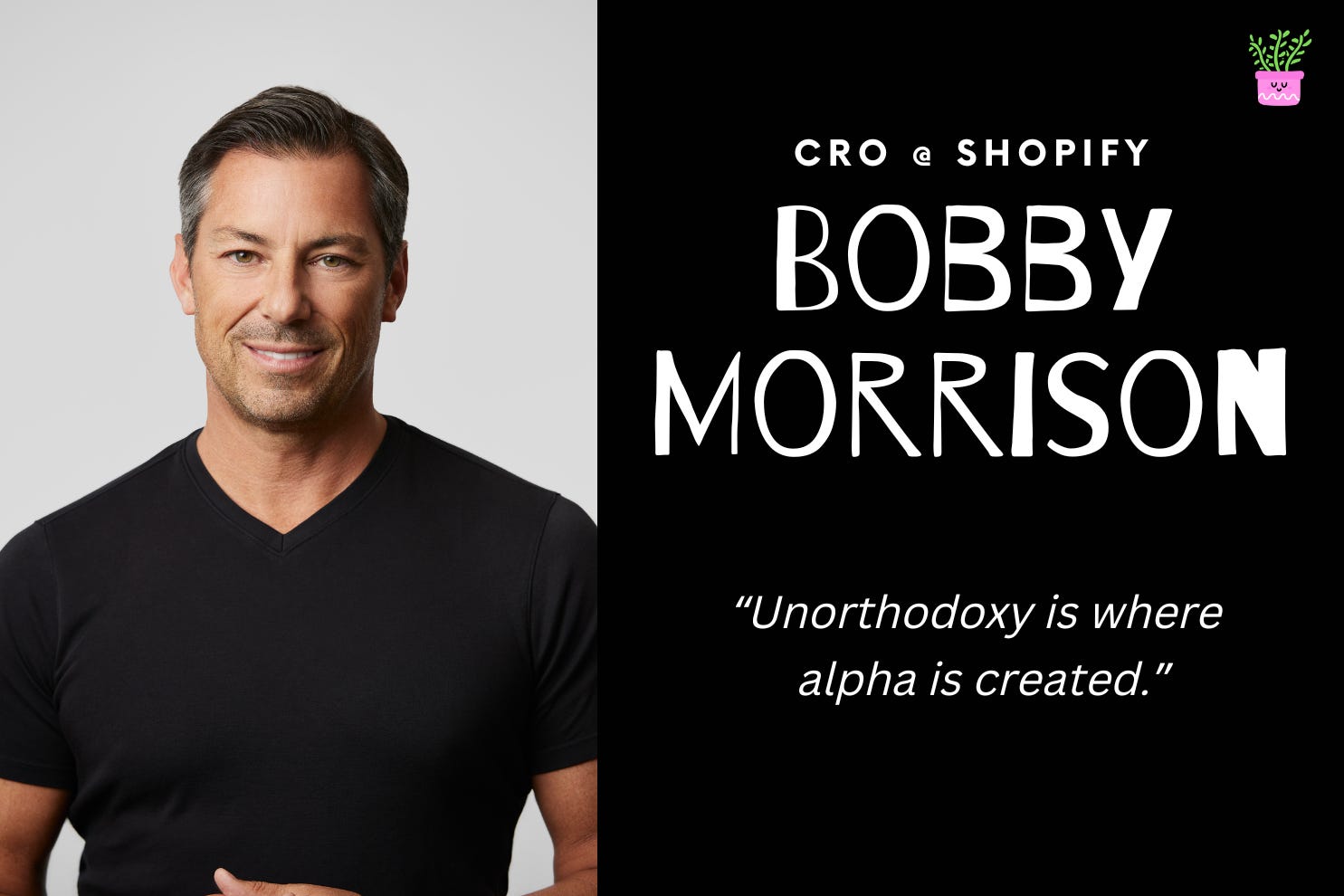
Today’s piece is shorter than usual, and a totally new style. Compared to the usual 10,000 word write up, this is a Q&A style letter between me and probably the highest profile guest I’ve had here so far—Shopify’s Chief Revenue Officer, Bobby Morrison.
Shopify needs no introduction. But if you’re not familiar with Bobby, here’s his incredible resume: Before joining Shopify in August 2022, Bobby has had leadership runs at Intuit, Microsoft, and Verizon. He’s also advised several companies, and one of my first questions was what main lessons he’s learnt across each company that have shaped him as a leader.
The style of this piece is as follows: I asked a question, Bobby sent me an answer, and I’ve also then added where relevant, my own comment per response, giving you some additional analysis.
It’s not the usual deep dive, because I’ve already written that here. If you haven’t read that piece I’d suggest starting there, although you don’t have to.

This is a follow up, because when I wrote about Shopify back then, they were not playing the enterprise game. Shopify in 2022 was deeply positioned as the #1 platform for entrepreneurship. In Nov ‘22, they were valued at $42.48 billion.
But, at breakneck speed—and also very much coinciding with Bobby’s arrival at Shopify—they’ve quickly launched themselves into the enterprise category and are already leading this section of the market.
Today, 18 months later, their market cap is $73.48 billion.
Yes, Shopify has deep resources to invest in expansion and aggressive go-to-markets to help win a pool of customers faster than most of us could ever dream of. But resources alone are not it—there are of course companies who’ve had war chests larger than some countries GDPs who have failed to get into new markets.
Shopify have executed this push to building the enterprise commerce operating system off so well, because they’ve focused on first-principles:
Spot the macro trend
Craft your insight
Lean into your unique advantages
Develop a strategy that stays true to the core mission
Clear the path of side quests, say no, and focus on main quest only
Find where the main value is, and amplify it
Find where the main friction is, and remove it
For this reason, there’s a lot to be learnt from this new phase of Shopify’s growth. A phase of growth that Bobby has his fingerprints all over.
This is also a timely piece given Shopify’s recent Q1 earnings call, touting great performance with $1.9B in revenue this last quarter (up 23% YoY).
Let’s get to it.
*This post is in paid partnership with Shopify
How Shopify is winning enterprise, with Bobby Morrison
1. To open up the floor, is there any guiding wisdom or business philosophy that’s really stuck with you over your career?
I embrace the concept of being “antifragile.”
It’s not just about overcoming challenges, but learning and improving because of them. I really value work environments that challenge the status quo and believe in continuous learning and improvement.
My comment:
I first learnt about the concept of "antifragility" when I read Nassim Nicholas Taleb’s book during lockdown.
Unlike fragile items (i.e a glass) which break under stress, or robust items (i.e a rock) which remain unchanged, antifragile systems actually improve and become stronger when exposed to volatility, randomness, and stressors.

The best example is us—humans. When we lift weights, the stress causes micro-tears in our muscle fibers. But with recovery, the body repairs these micro-tears and we grow stronger and more resilient.
In practice, there’s a few ways we can apply this at our own companies.
Seek out the challenge: Instead of avoiding what’s difficult and doing the comfy stuff, we should view obstacles as opportunities to learn, adapt, and improve our skill and product. For example, think about if there’s a conflict on the team that could be resolved, or maybe a hard question your team is skirting around—like a competitive threat or the risks of AI. If you position anything hard in your mind as a way to become more antifragile, you’ll find a new motivation and zest to do the difficult stuff.
Take big bets and prioritize experiments: You just have to try new ideas. Some of them will be low hanging fruit, but some may be radical that could bring step changes to growth vs incremental optimizations. You need to create a culture of testing both. What’s the saying? You have to fuck around to find out.
Build for redundancy and optionality: A key part of antifragility, which is super evident in Shopify’s business, is creating systems and strategies that allow a company to benefit from the unexpected. In short, that means building multiple revenue streams, expanding into new diverse customer bases (like Shopify with enterprise), and baking in flexible business models that can easily adapt to changing circumstances. If you found out a pandemic was going to hit next month, what would you do right now to protect your business?
Embrace small-scale stressors: One thing you can do (which relates to seeking out the challenge) is to intentionally expose your business to small-scale stressors. This is basically controlled risk-taking to build for resilience and adaptability. I have not done all these things personally, but in thinking about it now, practically this could be:
Controlled hackathons, where you give your team experimental projects within a short timeframe. This exposes folks to time pressure and resource constraints, and pushes them to think creatively.
Rotating roles and responsibilities, where periodically you have people get involved in other areas of the business, thus exposing them to new operational context, challenges, and working styles.
Simulating outages or failures, which helps the team prepare for real-life incidents. It also points out weaknesses in your systems, and helps to develop contingency plans.
Entering new markets or niches, which helps test your company’s ability to adapt to different customer needs and market conditions.
Basically, Bobby’s guiding philosophy on business is to create a company that not only survives, but thrives in the face of uncertainty, challenges, and the inevitable unexpected punch to the face.
2. Related, do you have any standout lessons that you’ve learned from your time at huge companies like Shopify, Intuit, Microsoft, and Verizon?
From my time at Shopify:
Shopify is the first founder-led company I’ve been a part of, and there is a clarity of mission that comes from our CEO and founder Tobi that is unmatched. The power of viewing everything as a product has a tremendous impact. We view marketing/ops/support/commercial as a product.
Parkinson’s law, the concept that the work expands to fill the time allocated for its completion. At Shopify, we apply that to bureaucracy–by giving it less volume, we allow more room for impactful work.
Unorthodoxy is where alpha is created.
The impact of saying “yes” to one thing is “no” to every other thing.
The power of “deletion” and building back better.
From my time at Intuit:
The value of leading indicators, real customer obsession, and how to regain “fresh eyes” on the business.
From my time at Microsoft:
The power and scale of a global partner ecosystem; growth mindset; and how to integrate, as well as the importance of commercial and product feedback loops (connective tissue).
From my time at Verizon:
What relentless execution really looks like, the power and outsized influence of great leadership, the importance of diving into the data as an external face of the business, and deep understanding of the “Rubik’s cube” called the P&L.
My comment:
Every experience we’ve had has taught us something big, and usually, that shapes the story arc of our careers.
But, we very often don’t actually sit down to think about it. We put in real time and work to do some job, but then move onto the next gig without putting in just a fraction of that time to figure out how that work changed our view on anything, or brought as some new perspective.
So my comment here is more of a challenge to you—find some time to think about just one thing you’ve learnt from each work experience you’ve had. And similar to Bobby’s examples above, avoid hard skill stuff like “I learnt SQL”, and think more about larger life/professional/perspective/philosophical takeaways.
For instance, one thing I learnt while being a bartender (outside of making some mean cocktails), is a teams energy, quality of craft, and speed of work is actually a lot higher when there is a lot going on. When little is demanded of you, you slow down to let your work fill the space, and with that slow down comes low energy.
Busy + direction = quality & velocity
3. Shifting gears to Shopify, what’s the difference between Shopify Core and Shopify Enterprise? How much of this initiative is dedicated new product, vs new marketing/positioning?
Our goal is to give enterprises the tools to build with the highest velocity across full stack, composable or headless with a lower total cost of ownership (TCO) to drive revenue. The larger a business, the more opportunities there are to leverage Shopify’s tools and scale. Enterprises get access to their own dedicated version of the Shopify platform that powers over 10% of U.S. ecommerce. We continue to build enterprise-specific value, such as controlled releases, unlimited locations, enterprise level support and SLAs.
My comment:
So, yes, there’s often net-new product that needs to be built to move up market. The needs of enterprises, while often overlapping in many ways with SMBs, are different.
By building a separate version of the Shopify platform just for these types of businesses, Shopify still gets to reuse key commerce components they’ve built over the past 16 years, but can bring extra power to a smaller group of users without adding complexity to the core interface for the bulk of their other customers.
A nice play.
In addition to that, I love this concept Bobby brings up of Total Cost of Ownership (TCO).
TCO is a financial estimate that helps determine the direct and indirect costs of a product or system over its entire lifecycle. It goes beyond the initial purchase price and considers all the expenses associated with owning, operating, and maintaining a piece of software.
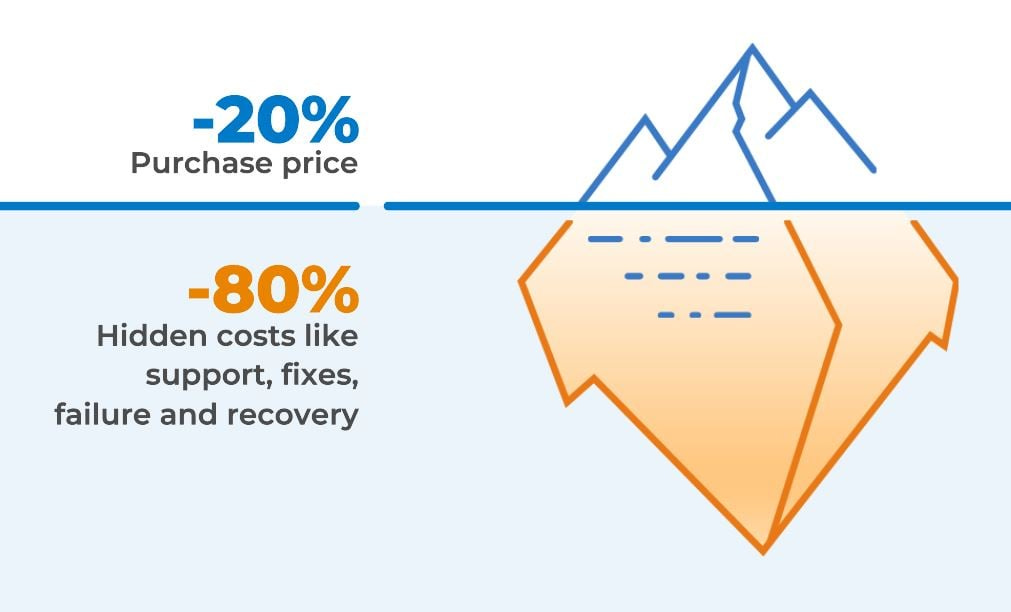
For a big company, the costs beyond the direct subscription or annual contract are often substantial. Which means for founders looking to move their product up-market to enterprise customers, understanding and leveraging the concept of TCO can be crucial in winning deals.
Here's 4 ways how you can use it:
Highlight your product’s long-term cost savings: Enterprise customers are often more concerned with the long-term costs of a product rather than just the upfront price. By demonstrating how your product can reduce costs over time through factors like increased efficiency, lower maintenance costs, or reduced need for additional hardware or software, you can make a pretty strong case for your product's value. The idea is to map out how your TCO over the next 5 to 10 years beats their current TCO, even if there’s a big upfront cost or effort. That’s how you can convince people to make a big switch.
Emphasize scalability and flexibility: Enterprise customers heavily index on choosing vendors where they see staying power. In other words, they don’t want to see a future where they outgrow your product and have to deal with changing tools. So, show how your product can easily scale up or down based on demand, and is adaptive with their growing needs.
Focus on reliability and support: Any downtime or system failures impacts productivity, and than can be incredibly costly to enterprises. This means you need to highlight that your product's reliability and level of support is best-in-class. This can include offering dedicated account managers, 24/7 tech support, or service level agreements (SLAs) that guarantee uptime and quick issue resolution.
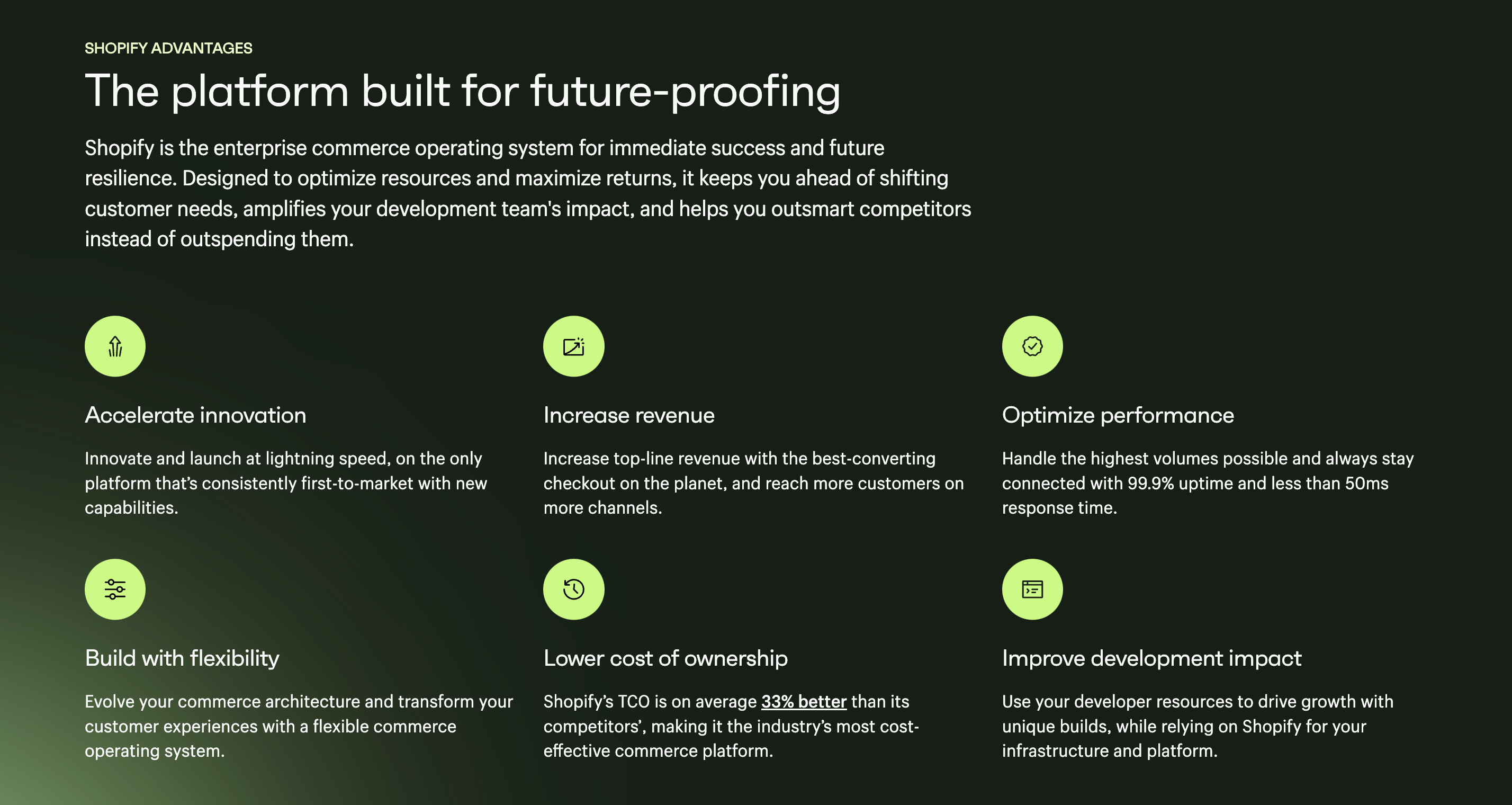
Provide TCO calculators, data, and case studies: Shopify is a great example of this. Their enterprise page is all about TCO, and they have the content, research, and tools to prove theirs is excellent. They know TCO matters, so they commissioned independent research to bring objective data to customers around where they can get the most bang for their buck. They also built a free TCO calculator, and have several case studies that demonstrate the long-term cost savings and ROI of their platform compared to alternatives. All these things can help your prospective enterprise customers understand the full financial impact of choosing your product and justify the investment to their bosses.
Basically, TCO is your friend in winning enterprise contracts and moving up market. Once you know all the things people care about in their buying decision, you can get ahead of it by addressing the TCO concerns. Here’s an awesome component Shopify use on their landing page for enterprise.
4. Why now? What was the discussion that led to Shopify for enterprises after 16 years? What tailwinds and behavioral/tech/cultural/societal/macro shifts contributed to this?
Our mission is to make commerce better for everyone. And when we say everyone, we mean everyone. We recognize that this new era of commerce is challenging based on market conditions, which are further amplified when a business’ commerce platform is inflexible and expensive. This market demands profitable growth from enterprises, and we see ourselves as a partner to enterprises on that journey.
In a recent survey we conducted with IDC, we learned that two-thirds of enterprise customers were looking to change their commerce platform in the next three years, prioritizing quick implementation and a cost-effective solution in choosing their new platform. We pride ourselves on speed to market and agility when it comes to moving businesses to Shopify.
Building a 100-year company requires constant innovation, and our investment in enterprise is another logical step in our journey to be the full commerce operating system for businesses of all sizes.
My comment:
There’s always some wave in the market that you want to catch. Timing is everything, even for a massive company.
And for Shopify, their timing was a mindset shift about profitability in a challenging market. Things shifted from crazy hiring sprees and big budgets to more survivalist and lean thinking.
This was Shopify’s wedge to get slow moving enterprises to make a big change, because by knowing what was being spoken about at the table (saving money), they made their cost saving (presented as TCO) a flagpole for their enterprise messaging.
If you’re thinking about launching a product or entering a new market, what’s something the buyers (and users if you’re doing PLG) in that community are speaking a lot about right now? Be an internet sleuth on Twitter and Reddit, track what they’re talking and complaining about. Follow the memes. Read the stuff they’re reading.
You want to get into their mindset and come up with a compelling why now for why they’d consider buying your product.
5. What is the number one thing you’ve come to learn that enterprise customers care about? Is there any element that if you get right and address upfront, you can completely streamline a sales process?
Everyone wants to grow in a really challenging market, and we help them do that in two ways: infrastructure and speed to market. Our powerful, reliable infrastructure and flexible products make the total cost of ownership very appealing. An independent study recently validated Shopify’s total cost of ownership is up to 36% better than competitors.
Second, our core value proposition of innovation, scale and ease of launch. Enterprise businesses are initially drawn in by the low TCO, but there’s so much more to Shopify. We take what's complex and make it simple - absorbing, not offloading complexity. We innovate faster than anyone - giving our customers the competitive edge they deserve. And we’re all in on Unified Commerce, which ensures a connected and consistent experience across all touchpoints. Not to mention our ecosystem of 8,000 apps on the Shopify App Store to solve for their changing business needs.
My comment:
This stood out to me: absorb, don’t offload complexity.
Basically, just make your customers’ lives much easier than they even expect you to.
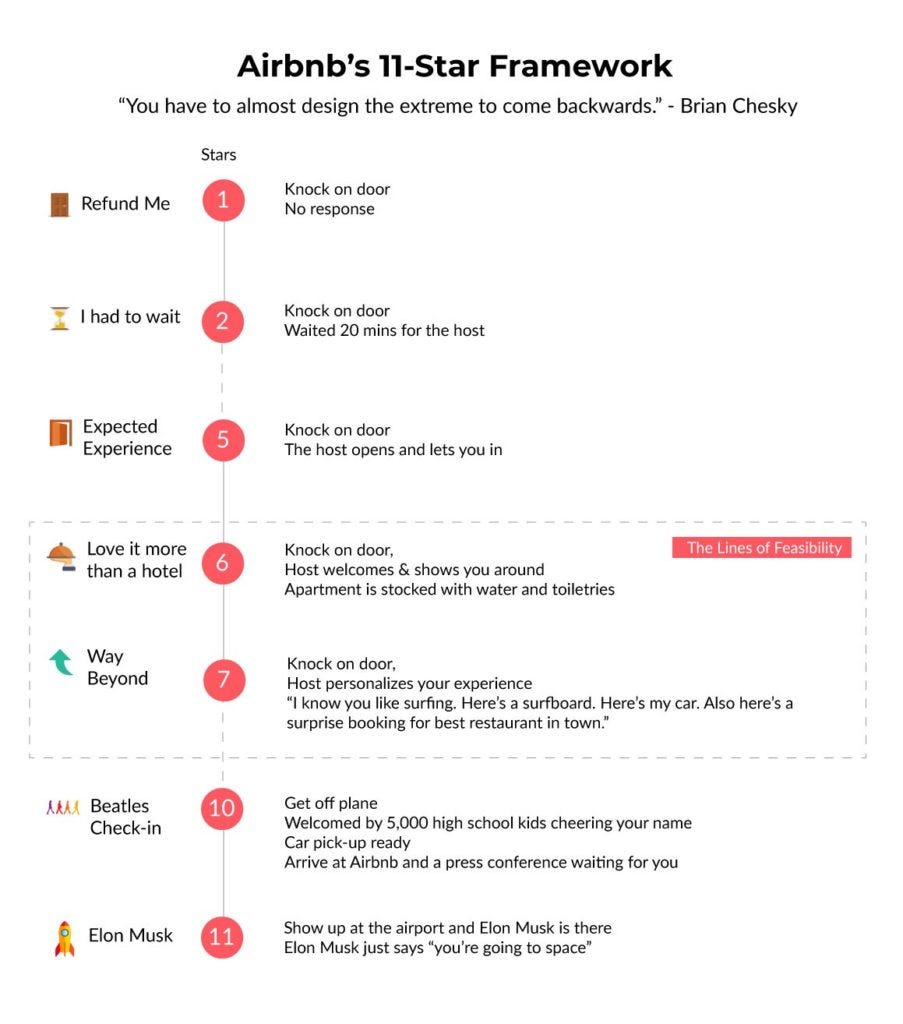
Similar idea to Brian Chesky’s famous 11 star experience framework. My advice, give an honest assessment of how many stars your product experience has right now in terms of delight and absorbing work for your users, and then think about what adding just 1 extra star could look like.
6. I heard you say that the logistics business which you recently sold to Flexport was a distraction. You said “No side quests, stay main quest”. And for Shopify, that main quest is commerce. Not CRM, not ERP, not marketing services. But commerce is a massive term, there’s D2C ecom, B2B, retail. On the enterprise commerce side, was there a GTM focus, and if so, how was that determined?
Our go-to-market strategy for enterprise is unified commerce – DTC, B2B and retail. We want enterprises to be able to centralize reporting and visibility in one place for both their physical retail stores, DTC channels and B2B. That makes unified commerce a natural GTM focus for us.
My comment:
We generally think about picking a small niche when entering a new market and then ramping up from there, but sometimes, we have to do the inverse.
We have to go big from the get go.
Why? Because a narrow focus can lead to missed opportunities and steeper competition.
Usually, the move is for startups to create a super narrow focus for their product. It’s always “How can you be more niche?”, “Get more specific!”, and “Be careful broadening your scope”.
But when you think about the problems your customers have, they often span a lot of different business systems or point solutions.
In fact, some of the biggest problems, and therefore the problems that potentially could give rise to the most valuable companies tend to be things that span a lot of different point solution products within a business. And therefore, only building one point solution product can't really address them.
Plus, by focusing on Unified Commerce with point solutions for all of these areas (B2B, retail, online, POS, etc), Shopify is really betting on a suite of products, with integration as a product.
Meaning, the types and the depth of integration you can have when you're building a set of related products together in-house is so much more powerful than what you can do through a set of APIs with other vendors.
There are usually a set of shared components across products (FYI Shopify is literally built on components), where you can identify certain bits of functionality or certain parts of the product that end up being reused. This is not just great for efficiencies, but also means you can afford to go much deeper and invest much more heavily on those critical pieces that are shared across these different products.
So, go forth and think bigger. But do so in a way that is 100% aligned with your long-term mission.
7. Having a great hook and pitch—which you do—is obviously key to acquisition. But enterprises often get caught up in the status quo. And the bigger the company, the harder it is for them to migrate from an A to B solution. How is Shopify thinking about removing friction, and in terms of onboarding, how does Shopify operationalize implementations with big customers to ensure these setup projects don’t go over budget or timelines?
We take a truly bespoke approach to facilitating the transition to Shopify for enterprise customers because ideally, Shopify is the last replatform enterprises ever need to make. Our enterprise-level offering meets businesses where they are. We know that replatforming is a massive change, so we offer extensive customization options and integrations that allow enterprises to tailor their sites to their customers and integrate existing back-end systems seamlessly using APIs. This flexibility can significantly reduce the hurdles associated with migration.
For enterprise clients, we offer dedicated account managers and access to a consultation team to help aid in this transition. These experts help execute migration with minimal disruption to the business.
We also place a big emphasis on detailed planning and scoping before official onboarding even kicks off. We work closely with our customers to understand their specific needs, goals, and any potential challenges.
From here, we leverage a robust toolset and framework that's specifically designed for large-scale implementations. These tools help automate and streamline parts of the setup, reducing manual errors and speeding up project timelines.
We also employ a phased approach to implementation, which helps massive projects feel more manageable. Instead of going live with everything all at once, the platform and its functionalities might be rolled out in stages. This helps catch and address issues when they’re still small and manageable.
My comment:
Enterprises require a lot of handholding beyond sales. And if you want them to find value so you can retain their business and upsell them in the future, it’s super important to think about touch-based enterprise onboarding almost as a product in its own right.
One bit of advice here is to create an internal knowledge-sharing repo where team members can share their experiences, lessons learned, and new ideas for improving the implementation process. The idea is to iterate on your process, find the bottlenecks, and have a smooth transition over from sales to customer success.
8. You started as a challenger in the space. But within just 2 years, you’ve been dubbed by Gartner a Leader in the Magic Quadrant. That’s just a true demonstration of operational and strategic excellence. When you were charting the path to get there though, what was your strategy kernel? Were there specific product, marketing, and partnership requirements you knew you needed to nail to win the enterprise market?
One of the observations in August of 2022 was that we had two key areas to prioritize before we entered the enterprise space: certain product requirements and a series of partnerships that we needed, both commercial partnerships for how we enter the market and product partnerships to extend our platform and interoperability.
We made some key investments, and at first, we were somewhat of a best kept secret for enterprise. Now, we’ve seen more retailers come over to Shopify that are billion dollar businesses, some of which are digital native and others that have been in operation for many years.
My comment:
Once you know a) where you are now, and b) where you want to be, the next step is c) agreeing on what the right pillars of development are to get there.
Essentially your pillars are how you close the gap, and they ultimately guide what your roadmap should look like and what actions your entire team need to focus on.
9. What do you see as the biggest threat or risk to Shopify's enterprise business, and how are you building walls to protect against that?
We know it takes time and resources for enterprise businesses to replatform to Shopify, and for some companies, that is a barrier to entry. I’m confident if we continue to build incredible products, remove the pain of migration, and partner on solutions that allow businesses to scale now and in the future, enterprises around the world will continue to choose Shopify.
My comment:
Sometimes the best way to build a moat around your business is to just focus on what you’re incredibly strong at, and thus what you can control.
Shopify isn’t directly concerned about competition or external threats—those are things outside of their locus of influence.
But what they can control is going deeper and wider on the problems that their market has. Building new features, improving existing ones, making their platform faster, doubling down on support, etc.
It’s a good lesson on not ignoring what’s happening around you, but also not spending too much time worrying about it. Most of the time, your biggest risk to losing customers is just failing to execute and deliver what they expect.
10. What areas is Shopify looking to invest in to a) lower the barriers to entrepreneurship, while b) raising the ceilings of scale, and for both sides of your ecosystem, c) help everyone do more with less.
We're supremely focused on making significant strides in B2B, offline, and international.
B2B is a massive opportunity that will allow businesses on Shopify to scale and find new revenue streams. We’ve shipped more than four dozen B2B features since launching in 2022. In Q1 of 2024, B2B GMV (Gross Merchandise Volume) grew over 130%, and we expect that growth to continue. Others do, too: We received status as a Leader in The Forrester WaveTM: Commerce Solutions B2B, Q2 2024 in our first year of participation.
With many digitally native businesses moving to brick and mortar or pop-up in-person shopping moments, our POS product can now connect offline brands with over 150 million buyers on Shop, through our new email capture feature.
We are laser-focused on building products and tools that cater to the unique needs and preferences of our international merchants. As we continue to diversify our product portfolio and extend our products into new countries, we will inevitably lower the barrier to entrepreneurship in these regions.
11. What are one or two big lessons that founders in other markets can learn from Shopify's successful push into enterprise?
Shopify’s platform philosophy has guided our successful scaling to enterprise. We focus on three main principles: optionality, composability and innovation.
Shopify offers choice in how enterprise businesses use our capabilities to build their commerce stack, our systems are designed to talk to each other and our vast third party integrations, and we offer the most innovative commerce technology and the freedom for enterprises to focus on their own roadmaps and create value for their customers.
My comment:
My takeaway here is flexibility.
We saw this last week when we looked at Attio—you want to build software that is largely unopinionated. Especially for enterprises who have very different workflows and needs from each other, building a platform that is flexible and doesn’t push customers into a corner seems to be incredibly important when moving up market.
Things are not always linear when it comes to workflows, and if you want staying power where your big customers don’t outgrow you, you need to think about optionality.
12. Tactically, how does Shopify make something complex and powerful behind the scenes while keeping it simple and intuitive on the surface? What lesson could be abstracted out for others looking to take inspiration from Shopify?
At Shopify, we remain focused on technical excellence. We spend a lot of time on our infrastructure, and this work often involves simplifying our systems. We must do this to keep innovating.
Our CEO and founder, Tobi Lütke, often says, “Not all fast software is great, but all great software is fast.” Some of the best returns on investment for Shopify have come from simplification.
My comment:
Don’t let tech debt accrue for too long. As you grow into a scale up, you should consider stepping back and making a habit of spring cleaning your infrastructure and thinking about how to keep setting yourself up for future success.
I love that quote from Toby: Not all fast software is great, but all great software is fast.
13. What trends are you seeing in ecommerce? Where is the puck moving in the next few years?
We keep close to our merchants, so we’re seeing a number of trends emerging in commerce and retail as a whole.
We see the incredible benefits AI will bring to our merchants and our business over the long term. We’re putting AI-powered products in the hands of more entrepreneurs, like our Semantic Search feature that yields more relevant results for shoppers and AI-enabled editing tools that generate studio-quality product images instantly.
We’re focused on helping entrepreneurs right now feel the impact of AI, and arming the next generation of businesses.
As in-store traffic has increased, we’re seeing digital native brands, including DTC ecommerce brands, moving into brick-and-mortar. Our POS products are designed to help these businesses expand into omnichannel retail.
My comment:
When it comes to playing where things are going vs where they are today, the number one thing you can do is to make sure you’re not building in a silo from your customers.
Startups are usually pretty good at being super close to users with things like interviews, community groups, etc. But larger orgs often start to rest on their laurels—they speak to customers less, focus on quantitative insights vs the qualitative, and build more from leadership’s ideas vs customer discovery.
If you want to be as close to where things are heading as possible, speak to more customers. Ask about what they’re worried about at work, what trends they’re keeping an eye on, what their customers are wanting, etc.
It’s not just learning about requirements, it’s learning about emerging needs that are not front of mind now, but may become so in a few years.
Adios!
And that’s it for our interview with Bobby Morrison!
To check out their new enterprise offering, hit the button below. You’re likely not a customer, but it’s interesting to just review their landing page and breakout of branding between regular Shopify, and Shopify for enterprise.
Otherwise, as always, thank you so much for reading! If you learned anything new today, you can sign up here for more issues.
See you Friday!
— Jaryd ✌️