👋Welcome to this week’s edition of 5-Bit Fridays. Your weekly roundup of 5 snackable—and actionable—insights from the best-in-tech, bringing you concrete advice on how to build and grow a product.
Happy Friday, friends 🍻
For all the folks here in the US, I know you have a nice long weekend to get to. So, I won’t dilly-dally with chitter-chatter this morning.
Besides some quick internal promotion, we can just jump right into today’s post.
In case you missed this week’s deep dive, a link is below. This was an incredibly fun analysis to write with Rex Woodbury, and I personally learned a ton about product, growth, and business building from Roblox— the $23B gaming, experience, and entertainment behemoth. 👇
Lessons on steadfast vision, platform building, vertically-integrated ecosystems, community as the product, and a peak into what a virtual country looks like
The AI is eating itself: How gen AI is affecting the Internet (so far)
Ideas are expensive
The future of media
Small ask: If you learn something new today, consider ❤️’ing this post or giving it a share. I’d be incredibly grateful, as it helps more people like you discover my writing.
(#1) The equation for making irresistible products
Shoutout to Peter Yang for writing—and teaching me— about a handy framework earlier this week. It’s called thevaluation equation.
Created by Alex Hormozi, author of the book $100M Offers, it’s a way to make an offer so good that people just can’t say no.
Made up of four components, it breaks down “what makes a product valuable”. It looks like this:
Source: Alex Hormozi
We don’t need to go back to school mathematics to know that the first two (sitting in the numerator of that equation 🤓) create value as they go up, and the last two erode it.
To zoom in a bit more:
Dream outcome: How will this improve my life?
The more people think your product helps them close the gap between their current reality and their dreams (e.g., status), the more they’ll value your product.
Perceived likelihood of achievement: How likely is this dream outcome to happen?
You can’t just promise the world. People need to trust in the dream outcome you’re selling. That’s why community and other social proof points are so helpful.
Time delay: How long will it take to get to that dream outcome?
Reducing the time delay is one of the most underrated ways to provide value. If you enter a competitive market with a product that’ll help customers achieve the same dream in half the time - you’ll win.
Effort and sacrifice: How much work will this take?
The less perceived friction (i.e. time and money), the more valuable the product. This is why so many people pay so much money for get-rich-quick seminars but don’t invest a little each month.
It’s easy to focus on just the top of the equation [i.e. being additive]. That’s where most products spend the most time, particularly on messaging. But, the bottom is equally important…if not more so.
And now that we have our math hats on, here’s another equation for you…
Join 6K+ people learning about product, growth, and company building.Free for now, not forever.
(#2) 0 failure = 0 growth
You certainly don’t know this, but I like to play Chess a lot. My brother lives back in South Africa, and we often catch up over Zoom and a Chess game. But, as a chess player, I am certainly risk averse. I try to protect my pieces at all costs, and “fear failure” in a sense with each move.
However, as an amateur player, there’s a lot wrong with that (which Chess.com isn’t ashamed to highlight in my post-game analyses). But, one thing it doesn’t call out is that by trying to avoid failure at all costs, I minimize my learning potential as a newer player.
So, earlier this week when I read a post by Ami Vora reminding us that without taking bets, without making mistakes, and without accepting failure as an outcome, we end up with the equation: 0 failure = 0 growth.
As Ami (CPO @ Faire, ex-VP Product & Design @ WhatsApp) writes, reflecting on her earlier career:
If I wanted to grow in my role and work on the cutting edge of the tech industry, I’d be doing new things every day — dealing with new team dynamics, new competitive pressures, and new tech developments all the time. If I wanted to keep learning, I had to embrace taking risks and trying something new, even if it meant others sometimes saw me fail.
Setting my personal dial to zero failures felt “safe”, but it also meant that I could only work on things that didn’t publicly challenge me. And it took years of slowly nudging that dial up to realize that it was okay — I could take more risks. I ended up forgetting how uneasy those stretches of growth felt, even while what I learned stuck with me.
AKA, if it’s comfortable, you’re not growing. And you should expect to be pretty bad at things you’ve never practiced. It doesn’t make you an imposter….it makes you a learner who understands an appetite for making mistakes is necessary.
This reminds me of one of my favorite ideas from Stoicism: the obstacle is the way. Captured perfectly by this quote from OG philosopher, Marcus Aurelius:
The impediment to action advances action. What stands in the way becomes the way.
…and illustrated well by this image from PJ Milani:
Just a little wisdom nugget to cap off the week. 🧘
(#3) The AI is eating itself: How gen AI is affecting the Internet (so far)
Earlier this week, Casey Newton (author/tech journalist at Platformer) wrote an excellent thought piece, sharing early notes on the effect of generative artificial intelligence on the broader web, and thinking through what it means for platforms.
Given we did a whole deep dive into a world-class platform yesterday (How Roblox Grows), I thought this was perfect timing.
To set the scene, here’s what James Vincent (The Verge) wrote after surveying AI-related changes to the consumer internet this year.
The underpinning premise to James’ full piece is this: Generative AI models are changing the economy of the web, making it cheaper to generate lower-quality content. And, we’re just beginning to see the effects of these changes as AI output is spreading rapidly to encompass more of the web every day.
Back in Casey’s post, he writes:
The rapid diffusion of text generated by large language models around the web cannot be said to come as any real surprise. In December, when I first covered the promise and the perils of ChatGPT, I led with the story of Stack Overflow getting overwhelmed with the AI’s confident bullshit. From there, it was only a matter of time before platforms of every variety began to experience their own version of the problem.
To date, these issues have been covered mostly as annoyances. Moderators of various sites and forums are seeing their workloads increase, sometimes precipitously. Social feeds are becoming cluttered with ads for products generated by bots. Lawyers are getting in trouble for unwittingly citing case law that doesn’t actually exist.
For every paragraph that ChatGPT instantly generates, it seems, it also creates a to-do list of facts that need to be checked, plagiarism to be considered, and policy questions for tech executives and site administrators.
When GPT-4 came out in March, OpenAI CEO Sam Altman tweeted: “it is still flawed, still limited, and it still seems more impressive on first use than it does after you spend more time with it.” The more we all use chatbots like his, the more this statement rings true. For all of the impressive things it can do — and if nothing else, ChatGPT is a champion writer of first drafts — there also seems to be little doubt that is corroding the web.
Casey goes on to cite two academic studies, which (to summarize) found two big problems:
Academics can no longer rely on crowdsourced research from popular platforms they’ve used before (like Mechanical Turk) since workers are admittedly using AI a lot (33-46% of them). “This, if true, has big implications. It suggests the proverbial mines from which companies gather the supposed raw material of human insights are now instead being filled up with counterfeit human intelligence”, says AI journalist Jack Clark.
Training AI systems on data generated by other AI systems (synthetic data) causes models to degrade and ultimately collapse. While the decay can be managed by using synthetic data sparingly (or not at all), researchers write, the idea that models can be “poisoned” by feeding them their own outputs raises real risks for the web. Why? Because AI output is spreading very quickly, and developers of AI models need to scrape the internet for data. This means, naturally, AI content will be cannibalized in the process.
In The Verge, Vincent argues that the current wave of disruption will ultimately bring some benefits, even if it’s only to unsettle the monoliths that have dominated the web for so long. “Even if the web is flooded with AI junk, it could prove to be beneficial, spurring the development of better-funded platforms, he writes. “If Google consistently gives you garbage results in search, for example, you might be more inclined to pay for sources you trust and visit them directly.”
Perhaps. But I also worry the glut of AI text will leave us with a web where the signal is ever harder to find in the noise. Early results suggest that these fears are justified — and that soon everyone on the internet, no matter their job, may soon find themselves having to exert ever more effort seeking signs of intelligent life.
For more world-class tech reporting, follow Platformer .
Thank you for reading How They Grow. This post is public so feel free to share it.
When it comes to ideas, Maarten Dalmijn says this:
We treasure all of our ideas. We don't want to lose any of them. We store them in a long list we regularly examine and revisit to count ourselves rich. The spreadsheet ROI makes us feel all warm and fuzzy inside.
We pile up all the work on our Product Backlog. We do not want to lose that pesky bug or that great improvement we will work on someday. Except someday never arrives, as the list keeps on growing like a hungry little caterpillar.
Simply, having a huge pile of ideas, lists of items to be worked on, or a big reservoir of work-in-progress sets you up for failure. Often when we plan stuff out (say, on the roadmap), we bite off more than we can chew. This makes it less clear what the main priorities are, and the team ends up working on too many things simultaneously.
By keeping our attention on “someday”, we lose momentum and focus around today. All those ideas and features to be worked on slow us down.
As Maarten argues, the classic trope of “Ideas are cheap. It’s the execution that matters!” isn’t necessarily true…
In fact, they are expensive. Don’t worry about not having enough ideas. You’ll always have enough ideas, and the good ideas will keep coming back. Worry more about having too many, and a subsequent long wishlist of things to do.
So, what’s the solution?
According to Maarten—an advocate for helping teams beat the feature factory problem—this is what to do instead:
We should eliminate ideas ruthlessly. Do you know the saying 'ideas are cheap'? That's a lie. Ideas are expensive and they become more expensive as you hold on to more ideas and for longer.
Set a clear Product Vision. The Product Vision provides direction, and the more clear your vision, the better you can eliminate ideas and work.
Have a Product Strategy. A Product Strategy is not a plan. It's where we choose to win. It allows us to apply the right focus, and empowers us to eliminate ideas and work.
Do discovery. Coding an idea and launching it to production is a slow way to find out you're wrong.
Avoid piles. You can't cook in a kitchen with piles of food and dishes. Over time mold will grow, and you will no longer be able to cook. The same applies to your ideas and list of work. Over time they become stale and moldy. Keep your kitchen clean and avoid piles if you want to serve customers swiftly.
Product Vision and Strategy may not be something you’re able to influence depending on your seniority level or position in the organization, but at least you can try to avoid creating piles and do discovery. In essence, discovery is about investing effort in ideas proportionately to your confidence in their success.
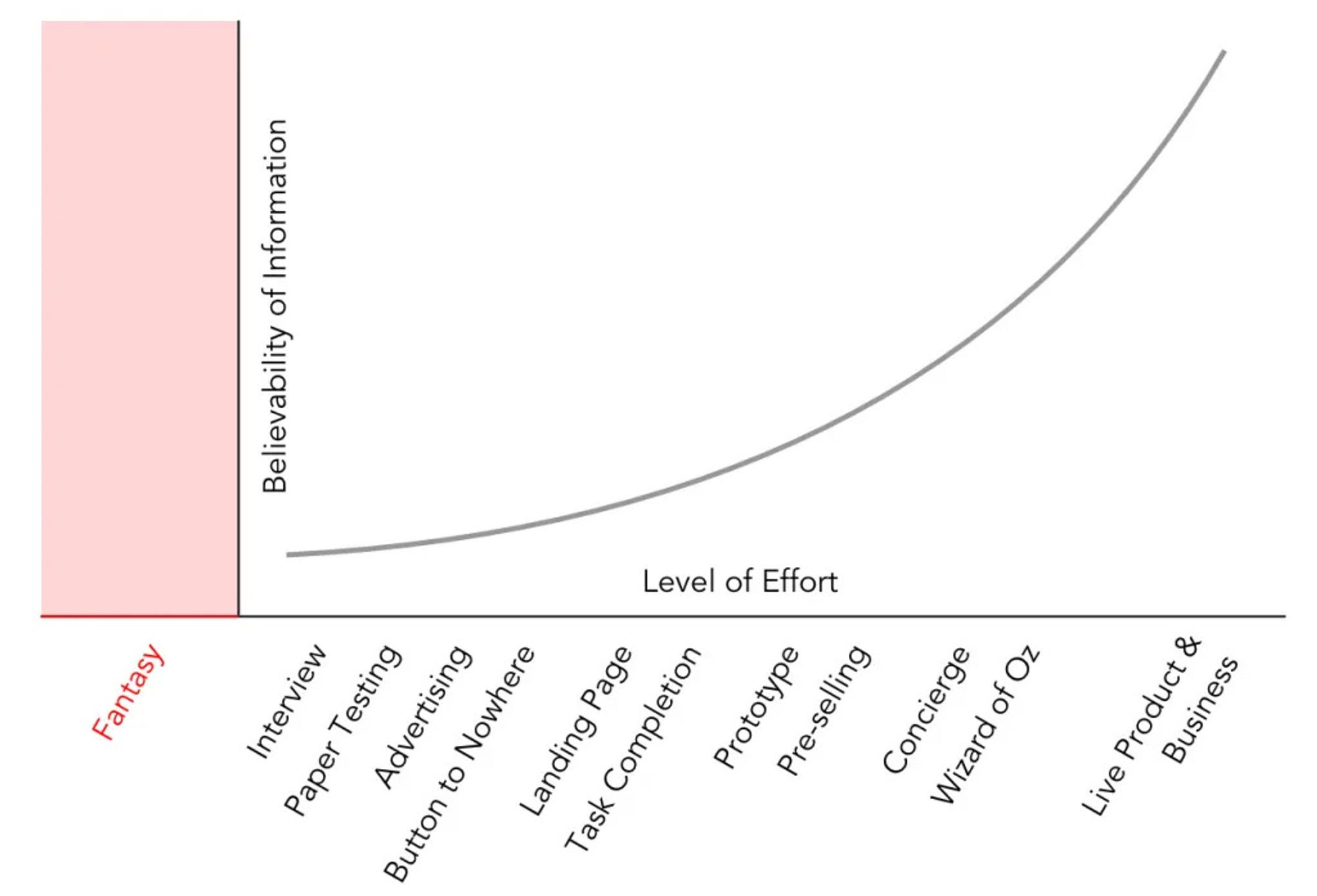
This is beautifully depicted in the truth curve by Giff Constable:
When you have little confidence, you should do cheap things and invest little effort to gain better information. And then, as you gain more confidence, you walk up the truth curve until you gain enough confidence that you believe it’s warranted to write slow and expensive code. Or you don’t work on it at all because you discover it isn’t worth the effort or rework it into something else entirely.
I read this post by Reid DeRamus last Friday, and before even getting through the first section I knew I’d be featuring this in today’s 5-bit.
Not only are trends and “The Future of X” fascinating things to learn about, but both as a product manager working for a content business in the media/entertainment industry and as an author/creator writing on Substack, his post really resonated with me.
I’m always excited to share Reid’s work because it’s just… 🤌
To get right to the good stuff, Reid describes three key trends he’s observed (as a Growth PM with a ton of experience in the world of media) shaping the future of the space:
Large media companies → niche media led by individuals and small teams. (learn more)
Renting audiences → ownership of audience. (learn more)
Ads-based internet → subscription-based ecosystems. (learn more)
If you’re interested in any particular trend, just hit the learn more link. Otherwise, here’s a quick summary to send you into your long weekend.
The internet has eroded distribution as a viable competitive advantage, and now the commodification of tech is making it even easier for creative talent to start their own media company. Further, we’re seeing early signs of major tech platforms starting to allow people to communicate with and own their audience, creating a much more stable environment to build businesses.
These are radical changes to how the internet operates. The net impact of these trends has been an explosion of lean media companies (i.e., operated by an individual or a small team), satisfying a wide variety of niches.
The origins of contemporary computer interfaces date back decades. Douglas Engelbart designed the mouse in the 1960s, and Alan Kay created the graphical user interface in the 1970s. Since then, countless alternative visions have been proposed with the goal of integrating computers more seamlessly into our lives.
If you’re curious about what the future of interacting with computers might look like, then this essay by Anna-Sofia Lesiv—which gives you a close look at the breakthroughs in mixed-reality tech—is for you.
Awesome! That’s everything for this week then, folks.
Like I always say—because I truly mean it— thank you for reading and giving me some of your time today. I appreciate it!
If you learned something new, or just enjoyed the read, the best way to support this newsletter is to give this post a like, share, or a restack. It helps other folks on Substack discover my writing.
Or, if you’re a writer on Substack, enjoy my work, and think your own audience would find value in my various series, I’d love it if you would consider adding HTG to your recommendations.
...as of now I can't help escape the thought that generative A.I. for content is akin to a tchotchke manufacturer...unlimited plastic nothings inevitably landing in the basement of some hoarder house or a landfill in the middle of the desert...the optimistic me thinks this means a great opportunity for those who provide unique human generated arts to thrive...but the pessimistic me sees already all the ways in which less than quality content is replacing things that at least tried...i've been laughing all week at the results of runway.ml's gen-2 text to video...sure the results will get better but even if they encroach quality for the variety of stock offerings on a service such as pond 5 will it ever eclipse it...and if so at what cost?...it took me a solid hour of prompts to get one ok looking four second clip that had an awful frame rate and would be usable primarily just to show someone a generative A.I. demo...i can't help but think that this A.I. surge is like many other surges in the tech space past where we seek to solve problems where there are none...what was really wrong with paying artists to create art when you needed it?...do we really want to live in a humanless creation vacuum?...the hilarity of the web in 5 years with A.I. articles built on the results of other A.I. articles being scrubbed by A.I. bot readers in the hope of generating A.I. ad dollars is truly dystopian...give me my can of spam soda already!...







...another great read dude...thanks...
...as of now I can't help escape the thought that generative A.I. for content is akin to a tchotchke manufacturer...unlimited plastic nothings inevitably landing in the basement of some hoarder house or a landfill in the middle of the desert...the optimistic me thinks this means a great opportunity for those who provide unique human generated arts to thrive...but the pessimistic me sees already all the ways in which less than quality content is replacing things that at least tried...i've been laughing all week at the results of runway.ml's gen-2 text to video...sure the results will get better but even if they encroach quality for the variety of stock offerings on a service such as pond 5 will it ever eclipse it...and if so at what cost?...it took me a solid hour of prompts to get one ok looking four second clip that had an awful frame rate and would be usable primarily just to show someone a generative A.I. demo...i can't help but think that this A.I. surge is like many other surges in the tech space past where we seek to solve problems where there are none...what was really wrong with paying artists to create art when you needed it?...do we really want to live in a humanless creation vacuum?...the hilarity of the web in 5 years with A.I. articles built on the results of other A.I. articles being scrubbed by A.I. bot readers in the hope of generating A.I. ad dollars is truly dystopian...give me my can of spam soda already!...
Oh my goodnessss!! Thank you for sharing & the kind words. :)
Excellent edition of 5-Bit!